
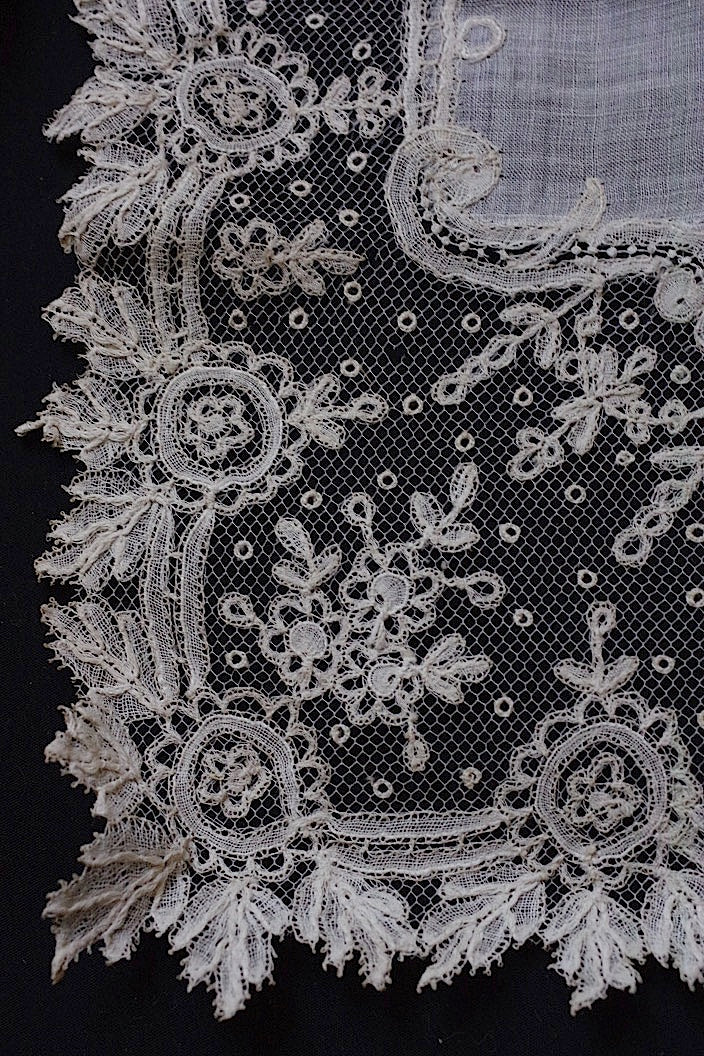
Point d'Angleterre Application Lace
As the name suggests, it developed in England in the late 18th century.
It further developed in the 19th century, characterized by a style in which lace motifs are sewn onto fabric for decoration.
A technique in which motifs are sewn onto a lighter tulle or thin fabric background for decoration.
Elegant motifs such as plants were favored. Since they could be arranged freely, each design could have its own unique character.
The following applies to other laces as well, in terms of following the same historical background. ↓
18th-century lace was characterized by intricate handwork and a strong symbolic meaning within aristocratic society, and was also technically very advanced.
In the 19th century, with the influence of the Industrial Revolution, machine-made lace appeared, and simpler designs suitable for mass production also increased. Floral and leaf patterns remained popular, but decoration became even more elaborate, and as the variety of lace types and styles expanded, it also became more widespread among ordinary people, broadening its range of uses.
 |
Characterized by delicate netting |
Point d'Angleterre application lace currently available in the shop ↓
0 comments